|
The Jerseyman |
|
|
Creating a WW II Crewmember Database for USS New Jersey (BB-62) Margaret Burgess, Radio Club
Early in April 2013 I was talking to Rich Thrash about the kiosk that he was working on that would contain the names of all the crewmembers that had served on the USS New Jersey. He mentioned that Jason Hall, our curator, had microfilm that contained copies of all the muster rolls for the USS New Jersey for World War II. They were hoping to print out the pages from the microfilm and try to create a database from them. Rich mentioned that he was going to try to “OCR” scan the pages (this means scanning the pages and have a special program interpret the graphics into a printable text format). There was no guarantee that this process would work.
This is where my background doing genealogy research came in handy. In order to do my family research I had subscribed to an on-line database website called ancestry.com. This site is constantly adding databases to the site and they had recently added a database of “U.S. World War II Navy Muster Rolls, 1938 - 1949”. I mentioned this to Rich and showed him some of the actual images. I then volunteered to create a WW II database for the USS New Jersey using ancestry.com. I figured it would be easy since it was indexed – boy was I wrong!The first objective was to get the listing of crewmembers onboard when the ship was commissioned on May 23, 1943. We wanted to do this so it could be added to the kiosk in time for the ships 70th Anniversary of her commissioning on May 23, 2013. I went into the online database and searched for a listing of all names on the USS New Jersey on May 23, 1943. I was expecting about 2,400 names - I got a list of over 4,800. After looking closely at the list I noticed each name was listed twice. Looking into the actual records it was determined there were two types of records: 1) A Change Record - which lists every time a crew member had some type of change to his status while onboard the ship and 2) A Quarterly Muster Roll – which lists every crew member onboard at the end of each quarter. Change Records listed 15 names at the top of the page and 15 lines below that corresponded with each name and gave the information about the change. Muster Rolls contained 34 names per sheet. Examples of these two documents are included below.I copied the index information and put it into a spreadsheet, eliminated the duplicates and ended up with a listing of about 2,370 names. Since we wanted more than just the names, I then went back to ancestry.com and asked for the first name on my list to see what other info was recorded on the Change Records and Muster Rolls. What I discovered was a wealth of info for each crewmember. The first record I found was a Change Record that recorded a sailor’s service number, when he enlisted, where he enlisted from, the date he arrived on the ship, where he was before he came aboard and the date he left the ship. Now knowing what information was available, I put the original list of names into a database and added fields for all the pertinent info given on the Change Record. I started with the first Change Records from May 23, 1943 and proceeded to fill in the info given for each crewmember that came aboard that day. This gave us a start of a history of every crewmember that served on the ship during WWII. Once I had finished the Commissioning Day Muster Roll, Rich incorporated it into the kiosk in time for the May 23, 2013 ceremonies.For 1943, there are over 763 images covering all the changes in crew. I went through every page and entered the info from every Change Record. These records included every time a crewmember came aboard, any rate changes, when he was transferred off the ship and the reason for transfer (ie… to another ship, to a navy hospital for treatment, for training classes, ..etc), and any disciplinary actions. For the most part entry went smoothly but there were some problems such as names misspelled and service numbers not matching. For each of these problems I had to search all the records (1943 - 1946) to see what the correct information was. Using the indexing feature on ancestry.com I would put the sailor’s name in the search feature asking for every time his name appeared on the muster rolls for the USS New Jersey. I then would check each of those records to see if it was a onetime problem or if the problem existed over several time frames. A onetime problem was easy to fix. However, with service numbers it became more complicated - I found some crewmembers who had 2 or 3 different service numbers during their stay on the ship. For those people I would usually keep the number that occurred the most in the records and add a special note in the database explaining the differences in service numbers. When there was a discrepancy with the names I would keep the spelling given when he came aboard and put a note in their database file.A Muster Roll of those present on the ship at the end of each quarter usually contained 70-80 pages of just names, rate, enlistment date and date they arrived on the ship. After entering names and changes for a quarter I would create my own “muster roll” and then compare my listing to the original Muster Roll. I always seemed to have more names in my list then were on the original Muster Roll. By comparing names I found that at times I would forget to put the “date left ship” in the correct field so I would fix my oversight. I also discovered that when a rate change occurred that promoted a sailor to “officer” standing he would no longer be on the crew Muster Roll so I had to add a line to their file saying “moved to Officer list” and then specify that any record with “officer” in it be excluded from my muster roll. In the same manner, there was a separate listing of those who reported onboard for duty in the “Aviation Unit”. I learned I had to exclude any records that said “Aviation” from my muster roll. Eventually, I had an exact match with the original Navy Muster Roll. That first muster roll comparison was the hardest, but I learned to add a separate line containing the word “officer” or “aviation” (and in future listings I had to add a line for “Flag Allowance” and then exclude them from my Muster Roll. The next quarterly Muster Roll comparison went much smoother. Eventually after several months, we finished the entire crew listing for 1943.One thing I did notice was that there were 3 different types of crewmembers onboard. There was a separate listing of all crewmembers who were in the “Aviation Unit” and later another listing of “Flag Allowance” crewmembers. Neither of these listings are included in the regular Muster Rolls but have their own separate muster rolls. Since these two units did serve onboard the USS New Jersey, their names and history are included in the database.I was now ready to start adding crewmembers for 1944 which is comprised of 663 images. This time it went a little easier as I knew what to watch for. As of Dec 10, 2013 we had completed all of the 1944 additions to the database. Below are some of the statistics I thought you might be interested in.
Between May 23, 1943 and Dec 31, 1944
Editors Note: We continue to make progress on this effort. Margaret is now entering names from the mid 1945 timeframe and I continue to enter names for the Korean War period of service. We don't have the detailed microfilm records for the Korean War period so we are forced to rely on Cruise Books to come up with the crew lists. There were as far as I know three Cruise Books published during that period, one in 1951, another in 1953 and a final one in 1955. So far I have finished entering the names from the first two books and have started on the third. We're hoping that by the end of the year we will have all the names from those two periods of service entered into the kiosk and then we can move on to the Vietnam and 1980s era crews. |
|
|
|
|
|
Sample Report of Changes Page. |
|
|
|
|
|
Sample Page from the Muster Roll of the Crew. |
|
|
« « « « « « « « « « « « « « « « « « « |
|
|
Seeking New Members to Join the USS New Jersey Veterans, Inc. Bob Dingman, Vice President / Reunion Coordinator
In the early part of 1980, a group of friends, who served on the USS New Jersey BB-62, got together in Champaign, IL. Champaign was the hometown of former crew member, Russ Brown. It was at this gathering, that it was decided, they would hold the first official reunion of former crew members at the decommissioning of the USS New Jersey in Long Beach, CA. The decommissioning was scheduled for January 12, 1983, so the group scheduled their reunion to coincide with that date. The only challenge to that first reunion was that then President Ronald Reagan was going to be home in California for Christmas 1982. So the decommissioning was moved to December 28th to allow the President to attend. Needles to say, the move upset some reunion plans, but thats typical Navy. The gathering went on and a second reunion was planned by former sailors who still loved the New Jersey. The original group began contacting fellow shipmates and at the next reunion in Atlantic City, NJ, nearly 500 attended.
It was on October 26, 1985, that Russell Brown, along with Attorney George Elwood and Edwin Fogelson, signed the documents that formed the Articles of Incorporation, making official, with by-laws and rules of membership, the USS New Jersey Veterans Association, Inc. Russ Brown remained President for 10 years and was instrumental in growing the association. Russ passed away on January 1, 2005.
The association is made up of former crew members, both Sailors and Marines, who served on the ship during WW II, Korea, Vietnam and the 1980's. Our primary function is our annual reunion. from our 1st reunion in Long Beach, CA, in 1982 till our 6th in Nashville, TN, in 1992, we held them every other year, Since 1992, we have held a reunion every year. Our 29th reunion will be held in St. Louis, MO, August 20 - 24, 2014.
The organization consists of approximately 1,000 former crew members. The reunion is held from Wednesday till Sunday. There is a Welcome Aboard party on Wednesday night. Organized tours of local sites are offered. There is a small stores, and hospitality room in the hotel. There is a Memorial Service on Friday where we honor the memory of shipmates who have passed away since our last reunion. On Saturday evening we have a Dinner Dance. Our magazine style newsletter, The Jersey Bounce, is published twice a year.
Each year, we award three college scholarships to children and grandchildren of current members who served onboard. We are currently working with the ship to organize fundraising for the many projects that are needed onboard. We give an annual donation, that is from our membership through an extra offering, at the time of membership renewal. Our primary purpose though is to bring together former crewmembers, on a regular basis, to keep our friendships alive and well. We hope that our reunions help sailors of each era start lasting friendships with those of their own and other eras. We have made it our responsibility to carry the history and legacy of our great ship into the future. Your participation is needed. We welcome all those who wish to join.
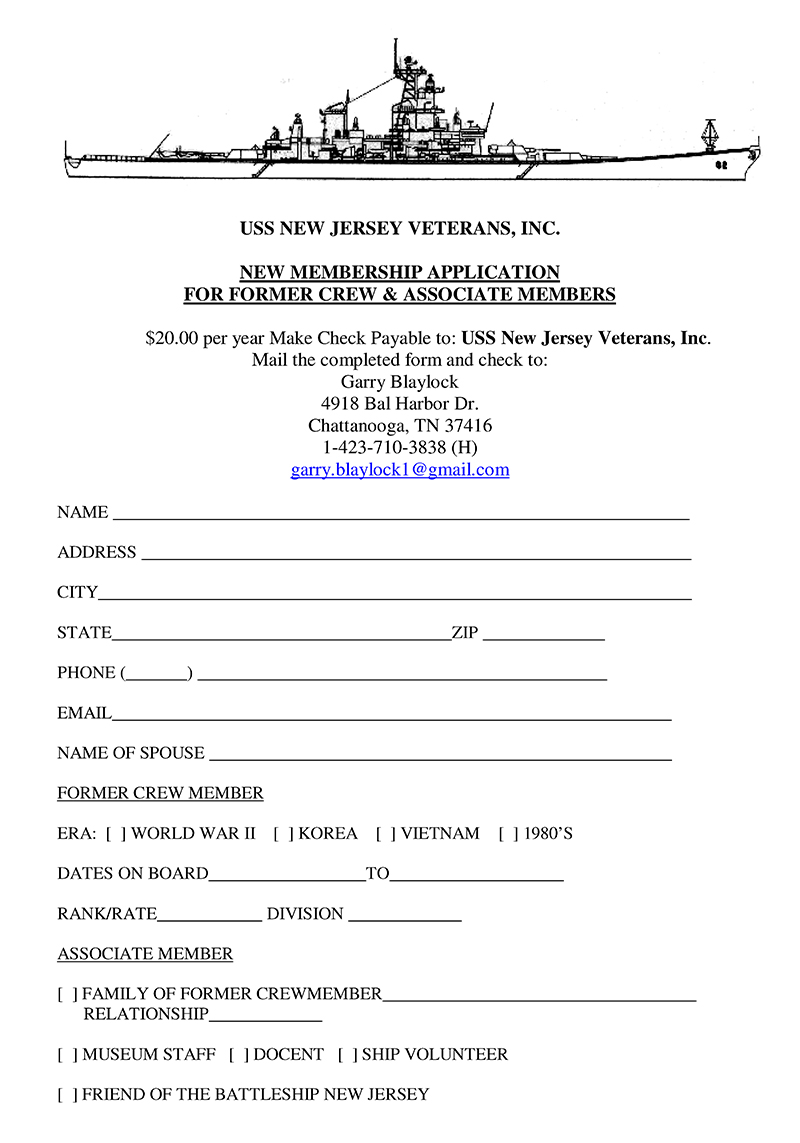
Below is a copy of the membership application. It is also available as a .pdf if you Click Here. |
|
|
|
|
|
« « « « « « « « « « « « « « « « « « « |
|
|
Navy Reserves Relieve Crew for Leave during extended Deployment off Beirut in 1983 Joel (Skip) Leeson, Commander, USNR (Ret.)
On December 28, 1982 the USS New Jersey came to life for the 4th and final time with Captain W.M. Fogarty Commanding. President Ronald Regan honored the Navy with his presence for the recommissioning.
The ship was modernized and now carried 32 Tomahawk Missiles, 16 Harpoon Missiles, and 4 CIWS. In June 1983, it was decided to start a Naval Reserve Unit at Navy and Marine Corps Reserve Center, West Trenton, NJ. This was the first reserve unit ever assigned to a reactivated Battleship. Iowa started one two years later. I was fortunate enough to be selected as the first Commanding Officer of that unit, the task was to build a unit of 125 sailors and 3 officers.
Over the Summer of 1983 New Jersey was operating on a short deployment in the Pacific and was ordered to the Panama Canal. She then proceeded through the canal and through the Gulf of Mexico. Next Captain Richard Milligan relieved Captain Fogarty and the ship began a high speed run to the Middle East, arriving on station off the coast of Beirut, Lebanon on September 23rd. The ships mission was to protect U.S. interests and the Marines ashore that were part of a multi-national peace keeping force and to provide a presence in Beirut that would in turn help establish the stability necessary for the Lebanese Government to regain control of their Capital.
On October 22nd ETC Michael Gorchinski went ashore to help the Marines with electronic equipment. He stayed overnight and the next morning, the Marine Barracks were blown up. We lost the Chief that day.
On November 28th, the DoD announced that New Jersey would be extended on station indefinitely. At that point, the Chief of Naval Reserve was contacted and it was proposed to have flights of reservists sent to the ship to relieve active duty sailors so they could go home for 3a 0 day leave. The Captain and crew were all for it.
My unit was the first to fly out. About half left the day before New Year's 1984. Because of commitments at home (wife had bad car accident) I sent my Executive Officer with this group. I went in the February, March timeframe. We were so successful that 5 flights were eventually sent, calling on reservists from all over the country. It was the largest peacetime crew relief in the history of the Navy.
We flew in DC-9 planes from Norfolk, VA to St John's, Newfoundland, to Lagos Azores, to Rhoda, Spain, to Sigonella, Italy, to Ben Gurion International in Tel Aviv. Then bussed to Haifa where the ship was at anchor waiting for us. We took a packet boat to the ship and our adventure started.
On February 8th the ship fired about 300 rounds at Druze and Syrian forces in the Bekka Valley. Some 30 of these shells were aimed at a Syrian Command post, killing the General commanding the Syrian Forces in Lebanon. Other targets included surface to air missile sites. I saw the BDA (Battle Damage Assessment). We hit everything we shot at.
Just before I left to go over, the State Legislature issued a Proclamation which I delivered to Captain Milligan. He in turn, gave me a picture of the New Jersey, plus a letter to the State, which I presented to Governor Kean.
The ship sent sailors on leave by priority. The sailors with children born after they left went first, then the newlyweds, after that it was by lottery. Over half the crew had leave.
It was an honor to be part of this. Something I obviously will never forget. From time to time I come across Sailors who either had leave from the ship or were reservists going to the ship. |
|
|
|
|
|
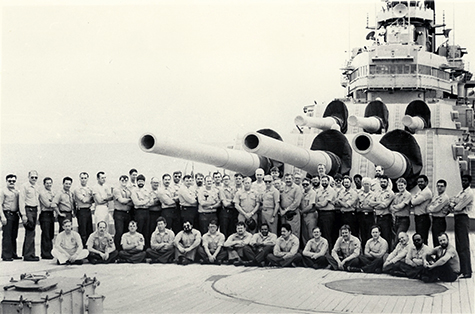
Reservists posing with Captain Milligan on the forecastle in 1984. |
|
|
« « « « « « « « « « « « « « « « « « « |
|
|
Battleship Volunteers Tour the USS Somerset prior to her Commissioning Rich Zimmermann, Overnight Encampment Volunteer
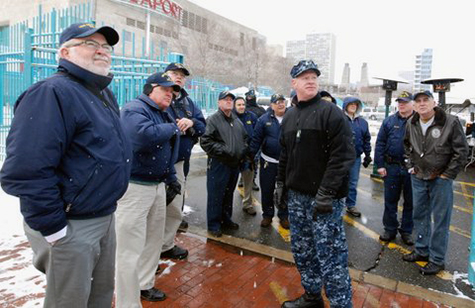
It was a cold, windy, snowy day on the Delaware and nothing much was happening. Wrong, a lot was happening. Philadelphia’s Penn's Landing was preparing to host another commissioning on March 1st.
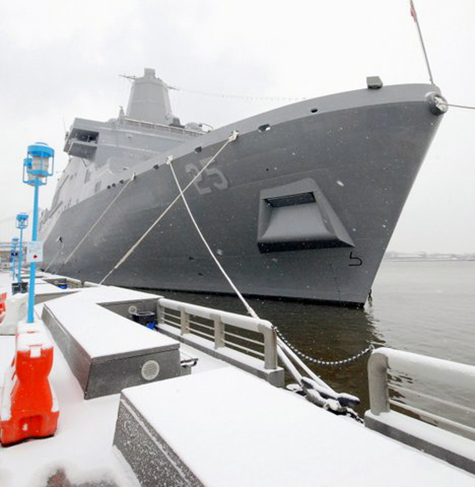
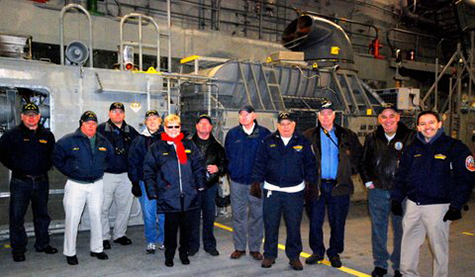
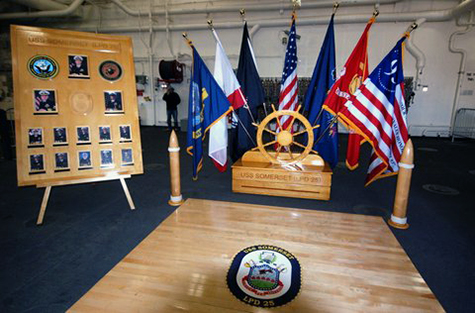
On February 26th our friends at the Independence Seaport Museum arranged a very special tour of the USS Somerset (LPD-25) for some of our crew members. The Somerset is the 3rd in a series of 4 special ships designed as memorials to those who died on 9-11. She is a memorial to the passengers and crew who were hijacked on Flight 93 and crashed in central Pennsylvania. Some of the salvaged beams from the twin towers were melted down and became part of the Somerset's keel.
The Somerset is a spectacular, modern ship full of the latest technology and spotlessly clean. It is crewed by about 380 select crew members who have been trained in the very latest technology. The middle management, Chiefs on up are professional, hard working and represent the modern Navy. In a few months, the Somerset will pass through the Panama Canal and be berthed at San Diego, CA.
She is a fitting tribute to the 40 innocent people who were murdered by terrorists on Flight 93. |
|
|
|
|
|
Shot of the Somerset tired up at Penn's Landing. |
|
|
|
|
|
The snow was
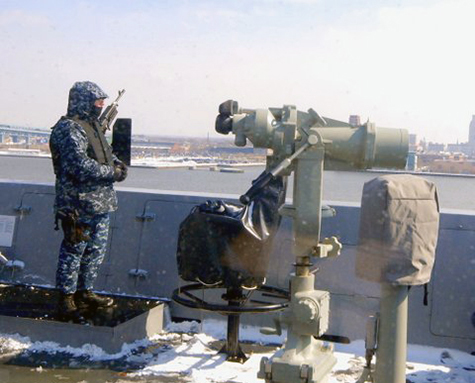
falling but these guys weren't going to let that |
|
|
|
|
|
Standing guard on the forecastle while in port, ever vigilant. |
|
|
|
|
|
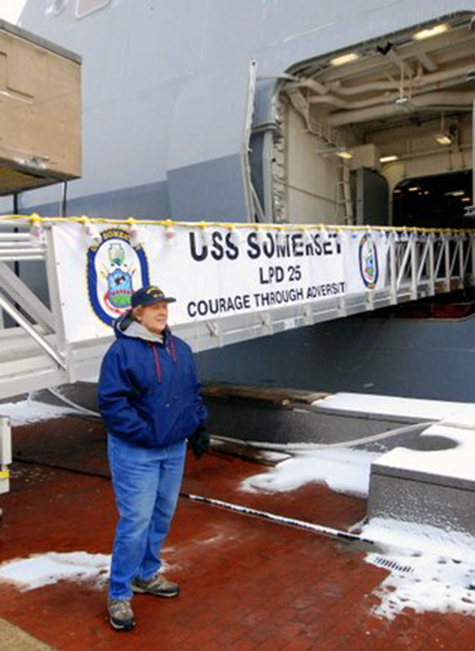
Interesting way of boarding the ship, let the tour begin. |
|
 |
|
|
Welcome Aboard! |
|
|
|
|
|
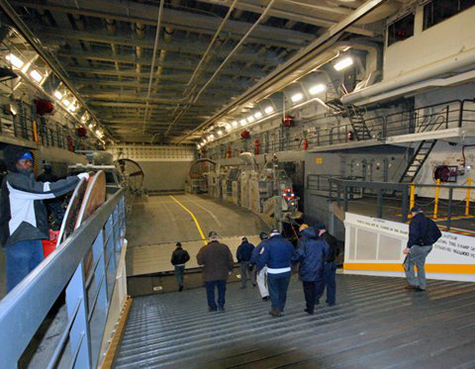
Wow, look at the cavernous interior of the hull, amazing! |
|
|
|
|
|
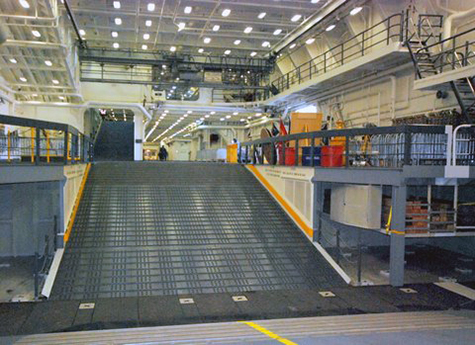
Fresh from the shipyard she looks spotless. |
|
|
|
|
|
Here the gang
pauses for a group |
|
|
|
|
|
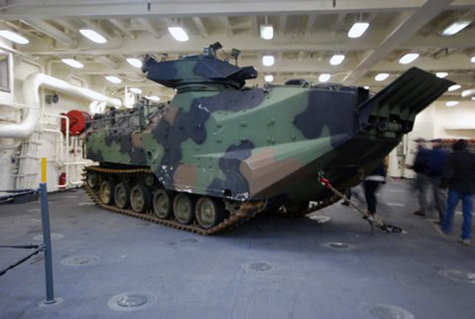
Marine amphibious assault craft onboard the Somerset. |
|
|
|
|
|
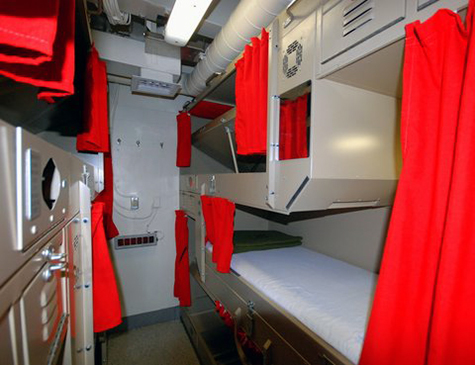
Crew bunk
space, sure looks a lot more |
|
|
|
|
|
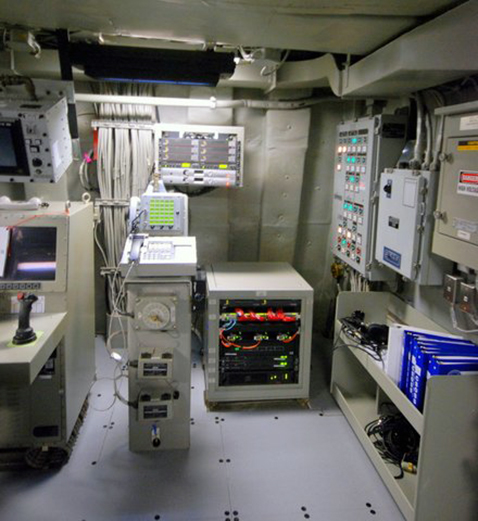
Welcome to
the modern Navy, some |
|
|
|
|
|
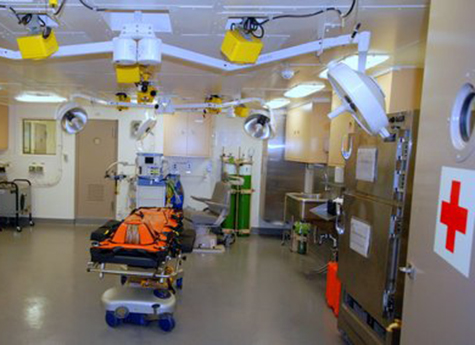
Ships Sick Bay looks like something
you'd |
|
|
« « « « « « « « « « « « « « « « « « « |
|
|
Page 5 of 8 |
|