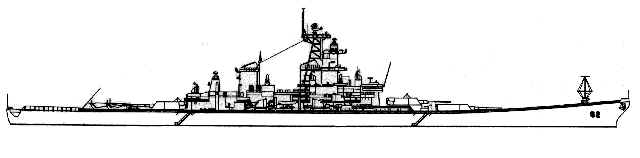
|
Total Run This Leg:
1,512.8
Nautical Miles
Total Average Speed: 5.24 Knots
Hours / Days This Leg: 288.5 Hours, 12.02 Days
Distance To Go This Leg: 1,435 Nautical Miles
Estimated Time Of Arrival: 7:00 a.m., Saturday, October 16
Present Course: 117 Degrees, Southeasterly
Winds: West-Northwest at 15 Knots
Seas: 4 Feet
Swells: 8 Feet from the South-Southwest
Barometric Pressure: 1009 Millibars
Air Temperature: 82 Degrees
Sea Temperature: 82 Degrees
Visibility: 10 Miles
Skies: Partly Cloudy
Sea Floor: The ocean depth in this area is 2,300 Fathoms or 13,800 Feet. Position:
USS New Jersey is now 44 Miles Southwest of
Laguno Papagayo, near Mexico's most famous resort area of Acapulco.
BB-62's Reservation At Panama
In less than two weeks, the USS New Jersey will arrive at
the Pacific, Northbound entrance of the Panama Canal, prepared to transit through its
locks to an historical tenth and final passage on her way home.
The Canal is a colossal achievement of design and
construction, created through decades of controversy and human sacrifice early this
century and last, and today is a thriving enterprise without which the world's commercial
shipping would cease to be as it is now.
Statistics available from the Panama Canal Commission,
currently a bi-national U.S-Republic of Panama authority overseeing canal operations, show
that between 1983 and 1997, the total number of vessels transiting the Canal ranged from
11,230 in 1983 to 14,747 in 1997.
More vessels each year pass from the Atlantic to the
Pacific (Southbound) than from the Pacific to the Atlantic (Northbound). The greater
number of Southbound vessels annually surpassing Atlantic-bound traffic amounts to some
200 - 500.
The amount of cargo passing through the Canal has grown
steadily, from a total of 145.5 million tons in 1983 to 189.8 million tons in 1997.
A total of 190.3 million tons was shipped through Canal's locks in 1995. Tolls collected
for this service grew from $287.7 million in 1983 to $493.3 million in 1997.
Each vessel usually requires about 24 hours in Panamanian
waters, 8 to 12 of which is spent actually passing through the canal system. USS New
Jersey's upcoming transit later this month was decided months ago, and a specific date and
time were assigned to her passage.
Every vessel, commercial or otherwise, must secure a
reservation to transit the Canal, which identifies the exact day and time of passage. The
result of simply showing up at the north or Southbound entrance without a reservation is a
lengthy delay of the vessel's progress, because of the volume of traffic handled there.
USS New Jersey's passage is assured. She will have
a welcoming at Balboa's Pacific northbound entrance, and will complete her transit a few
days later. She will then be headed home, for the last time.
Submitted by Bob Wernet onboard the Sea Victory.
|